Tuesday, 18 October 2016

Christine Richard reveals more of the reality hidden behind the 'Herbalife (HLF)' fairy story.

See original image
Christine Richard


Herbalife's Qualification Crowd Is In Trouble


By Christine Richard

Summary

Herbalife has less than a year to prove to the FTC that its US business is based on sales to distributors with Retail Customers who purchase products at prices that generate real profits.
We consider the buying patterns of a small and highly influential group of Herbalife’s top distributors who account for an outsized share of the company’s sales.
We find standing qualification orders, phony accounts, collapsing pyramids of qualification buyers, millions of dollars of products donated to charity and thousands of dollars spent on storage space – all suggesting top distributors lack Retail Customers.
By the way, Herbalife would prefer if you didn’t call these top distributors to ask them about how their businesses operate.
Remember those Herbalife (NYSE:HLF) buttons? "Earn What You're Worth." It's time to find out what that really means.
On July 15, the Federal Trade Commission (FTC) imposed new requirements on Herbalife Ltd. and its payment of commissions. In a Stipulated Order for Permanent Injunction and Monetary Judgment, the FTC and Herbalife agreed that after May 2017, Herbalife must principally pay rewards on three types of transactions: (1) sales by a distributor to a Preferred Customer (a distributor who signed up with Herbalife in order to buy the products at a discount for personal consumption but who is not pursuing the business opportunity), (2) sales to Preferred Customers in a distributor's downline organization, and (3) Profitable Retail Sales by Supervisors in a distributor's downline to Retail Customers outside the Herbalife distributor network.
In yesterday's article, we discussed why we think Herbalife will fall short when it comes to Preferred Customers. We looked at a proxy for Preferred Customers and determined that less than 2% of Herbalife's US sales are attributable to distributors who signed up only to consume the product at a discount.
Now we consider the other 98% - sales to distributors who signed up with Herbalife in order to pursue the business opportunity. What are these distributors doing with the products they purchase? Do the majority resell products to Retail Customers? For Herbalife's US business to survive the FTC settlement, they have to.
FTC Sees Insufficient Retail Demand
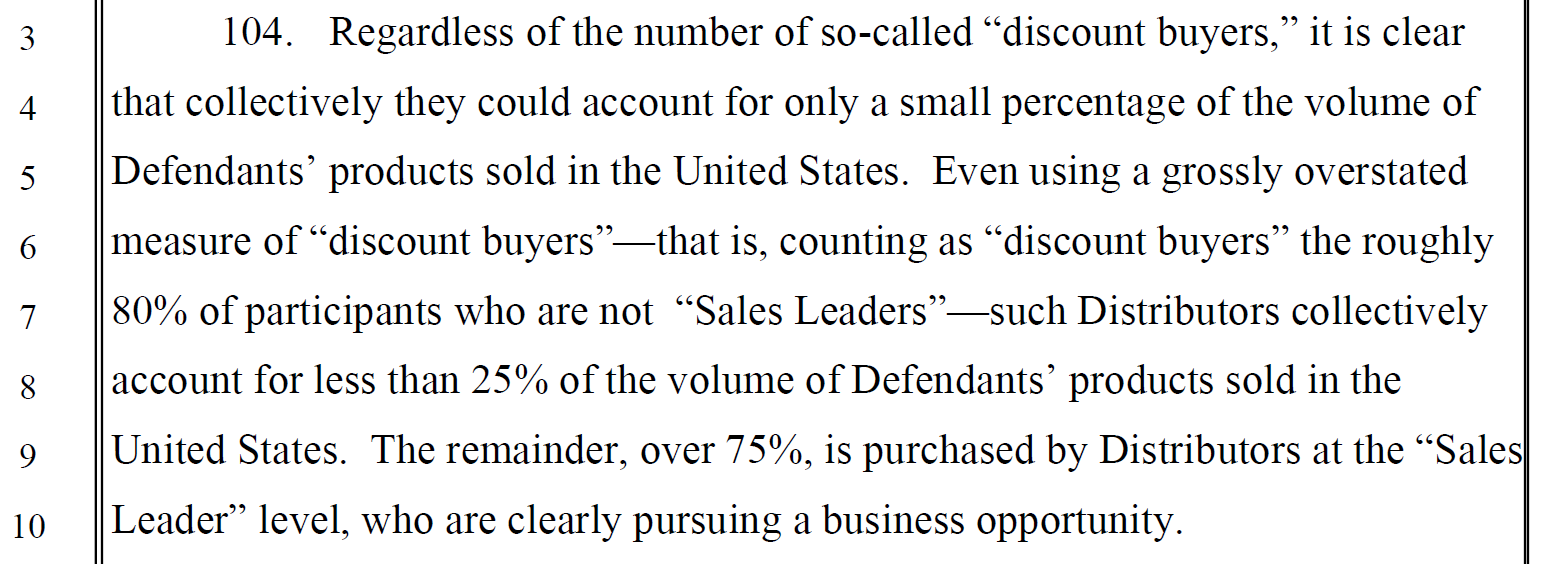
While Herbalife continues to insist that the vast majority of its products end up in the hands of Retail Customers, the FTC disagreed. The agency found little retail demand for Herbalife products and certainly not at resale prices that generate material profits for distributors. The FTC mentioned this several times in its Complaint for Permanent Injunction and Other Equitable Relief, which was filed in Federal Court on July 15, 2016 and publicly released alongside its proposed settlement agreement with Herbalife:
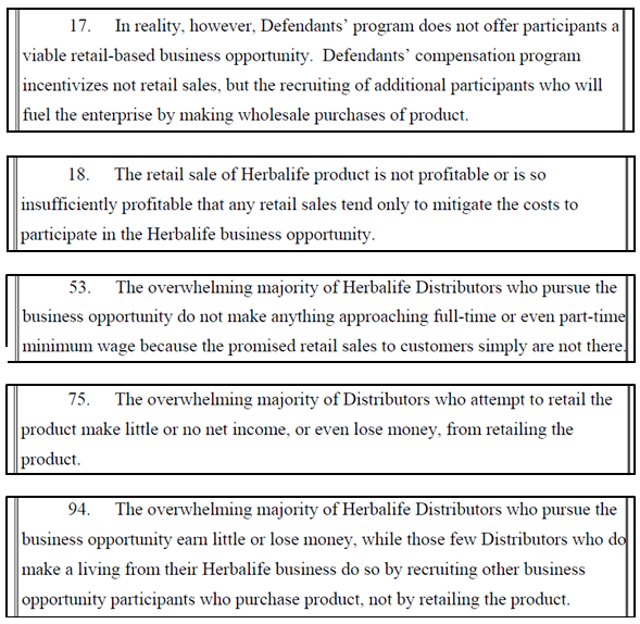
If all this is true, how is it that Herbalife's top distributors are running successful businesses? If they can't retail the product themselves and the huge number of people they recruit can't retail the product, what exactly are they doing with it?
Don't Ask
One group of Herbalife distributors is key to answering this question. These are members of the TAB Team and higher, a tiny but influential group. They make up the Millionaire Team, President's Team, Chairman's Club and Founder's Circle and are Herbalife's highest paid distributors, receiving tens of thousands or even millions of dollars a year in commission and bonus checks.
In our previous article, we used various data sources, including the recent FTC complaint, to determine how much of Herbalife's US sales can be attributed to purchases by various categories of distributors, including those in the TAB Team or higher:
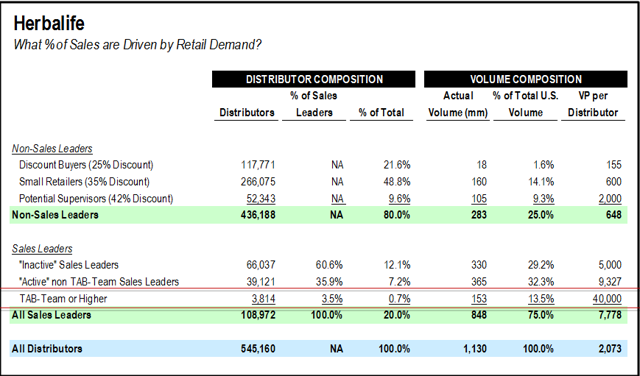
As the table above shows, "TAB Team or Higher" members account for just 0.7% of all distributors, but as a group purchase 13.5% of Herbalife products sold. We also estimate that these distributors each purchase about 40,000 volume points per year. That's the equivalent of around 1,670 canisters of Formula 1 a year, or 140 canisters a month.
How can we possibly square this with the FTC's statements that there is no real retail opportunity for Herbalife products? What in the world are these top distributors doing with the products?
One way to get to the bottom of those questions would be to simply ask top distributors about their businesses. But Herbalife is discouraging this approach.
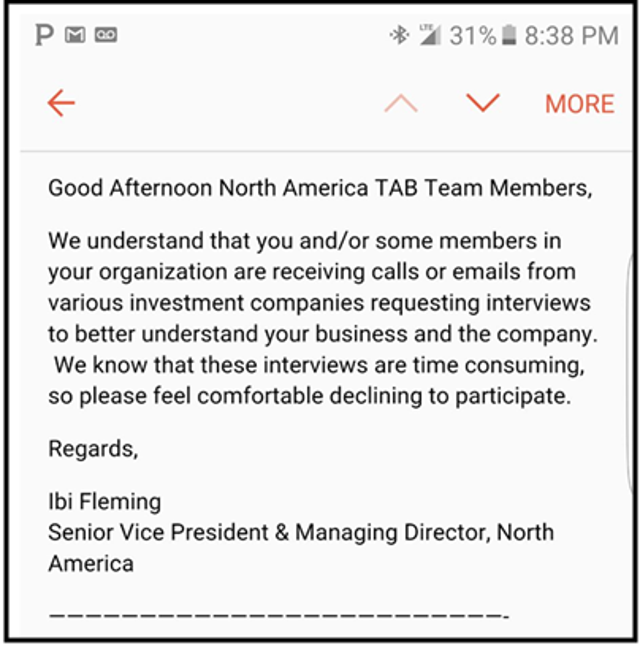
Here's a message the company sent to TAB Team members shortly after the FTC settlement was announced:
Here's another message, posted by an influential Herbalife distributor who also runs a business helping Hispanic distributors in the US with accounting and tax issues:
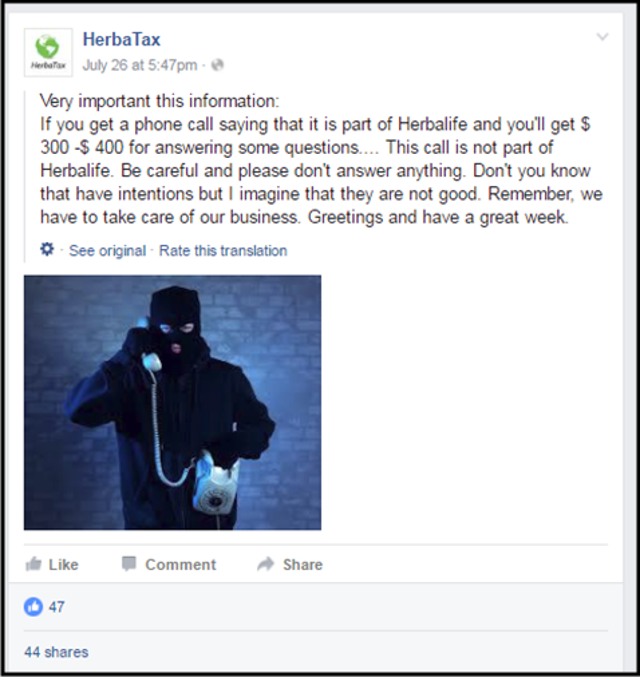
It's interesting that HerbaTax encourages Herbalife distributors to turn down $300-$400 "for answering some questions," while the FTC found that half of Sales Leaders average only $5 per year in net profits.
We haven't tried to reach any of these distributors since the FTC settlement was announced, but based on the above, we suspect trying to interview members of this group won't be a fruitful exercise.
That doesn't mean we can't find clues to how top distributors operate their businesses.
The Petersons' Standing Order
Susan Peterson is one of Herbalife's top distributors. She has frequently been named the #1 Herbalife distributor in the world and is one of a handful of distributors who are part of Herbalife's Founder's Circle.
We get a glimpse into how Susan Peterson manages her business in a document filed as part of a legal dispute over assets jointly owned by her and her late ex-husband John Peterson.
These documents describe the operation of numerous companies and accounts jointly owned by the Petersons. Included in the documents is one detailing the operation of J&S Vision Marketing, Inc. - a company that is 50% owned by John Peterson's estate and 50% owned by Susan Peterson, which operates the couple's Herbalife distributorship.
According to the document, J&S Vision Marketing has contracted with an administrator to oversee aspects of the business. Among the administrator's responsibilities is to monitor sales volume and purchase 2,500 volume points of products from Herbalife every month without fail:
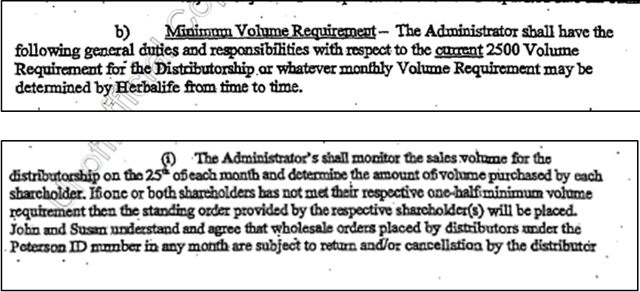
Under Herbalife's compensation plan, distributors need to purchase 2,500 volume points a month in order to qualify for the maximum commission on their downline Supervisors' purchases. Herbalife also counts purchases made by non-Supervisors immediately underneath the distributor toward this threshold.
We have no idea how many non-Supervisors Susan Peterson has in her organization at any given time, though one would expect there to be many if Peterson continues to actively retail, recruit and teach recruits. One would also, of course, expect Susan Peterson to have developed and maintained a substantial base of her own loyal retail customers over the decades that she's worked as an Herbalife distributor.
Instead, the standing order makes no mention of existing Retail Customers and recognizes that the purchases by non-Supervisors in the Petersons' organization can't be counted on. Therefore, the standing order has been established to assure that the Petersons' distributorship earns its maximum commissions every month.
This is qualification buying, and Susan Peterson has outsourced it to an office manager so she doesn't even have to think about it.
$8 Million in Donated Product
The Petersons aren't the only ones at the top of the Herbalife marketing plan who engage in qualification buying. Sometimes that qualification buying is more complex and involves multiple accounts, as the FTC noted in its complaint:
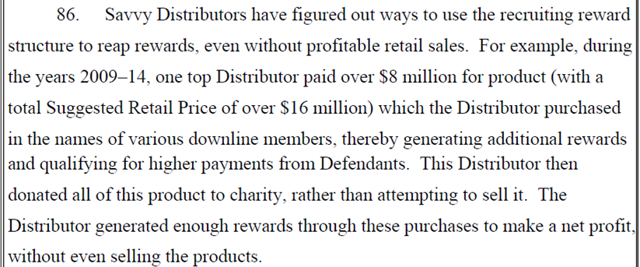
Not only was this distributor buying products for which he or she had no Retail Customer demand, the distributor also was buying for numerous accounts in his or her downline organization for which there was no underlying Retail Customer demand.
When a distributor sets up multiple accounts, buying product under those accounts and earning commissions, this is known as "stacking." Each account allows the distributor to reach further down into the pyramid, taking multiple commissions on the massive churn that occurs as people attempt the business opportunity.
Stacking is prohibited under Herbalife's compensation plan and so is qualification buying. Yet both have clearly been used with impunity by those at the top of the marketing pyramid to qualify for layers of commissions.
Kim's Collapsing Pyramid
Sometimes qualification buying extends to an entire organization, and Korean Chairman's Club members Tai Ho Kim and Hyun Mo Koo provide us with an excellent example. They are among Herbalife's most successful distributors and, like Susan Peterson, are members of the exclusive Founder's Circle.
Herbalife inadvertently revealed some details about Kim's business in an email sent by an Herbalife executive to the head of the Herbalife Family Foundation, in support of Kim receiving the Foundation's annual Humanitarian Award in 2013. The email appeared on the Foundation's website.
In the email, the Herbalife executive tells a story of how Kim's business, which was generating $500,000 a month in Herbalife commission payments, collapsed after Herbalife's now late founder Mark Hughes postponed the opening of the Korea market.
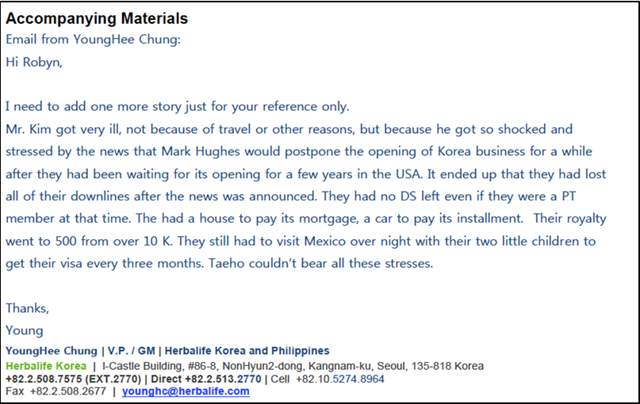
If Kim's organization had been composed of distributors with actual Retail Customers, his downline would have continued to purchase product even after the news of the delayed market opening. Distributors in his downline might have been disappointed by the loss of recruiting opportunities, but they wouldn't have stopped buying products from Herbalife altogether. The problem was that their purchases were driven by a desire to reach a high position in the marketing plan ahead of what was expected to be a dramatic expansion in the number of potential recruits in Korea. That's called qualification buying.
Doran Andry's Storage Space
Another one of Herbalife's most successful distributors is Chairman's Club member Doran Andry. We get a glimpse into how Andry's business works thanks to details provided in his ongoing divorce battle in California. Filings in that case include financial information for Andry's Herbalife distributorship, which is run through a company called HB International Group, Inc.
In 2014, HB International reported $2.6 million in commission and bonus payments from Herbalife. Yet, the business reported just $15,700 in revenue from product sales. It seems that while Andry earned huge commissions on the volume purchased by people recruited into his organization, his own retail business was a disaster.
HB International generated just $15,730.43 by selling products (which we assume to be Herbalife products), while also reporting that it spent $142,557.55, in two separate line items, to buy what we assume are Herbalife products. (We believe F.S.S. stands for Financial Success Systems, another company owned by Andry.)
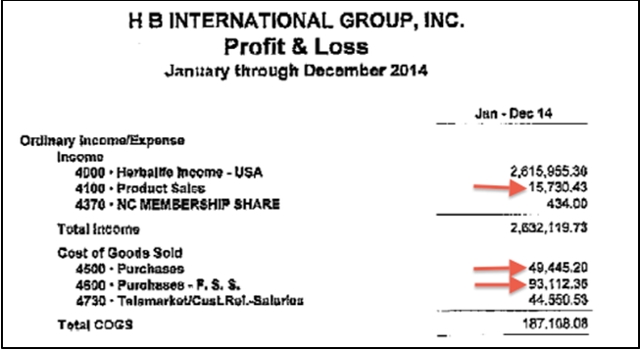
If these goods were in fact Herbalife products, then Andry bought products with a Suggested Retail Price of around $284,000 and made just$15,700 selling them.
This wasn't a one-time problem either. In 2013, HB International reported revenue from product sales of $32,419.99 and product purchases of $196,699.68, the equivalent of $394,000 in Herbalife products at the Suggested Retail Price.
Why does Andry buy product that he can't sell? In 2014, his purchases helped to qualify Andry for $2.6 million in commissions, and in 2013, the product purchased by Andry and his downline distributors unlocked $2.9 million in commission payments.
What in the world does Andry do with all the products that he doesn't sell?
One of HB International's larger expenses is an item called "Public Storage," which amounted to $55,113.00 in 2014.

We don't know what Andry's Herbalife distributorship is storing in all that space, but it sure would hold a lot of unsold Formula 1.
Missing Retail Demand
Will Herbalife's top distributors be able to meet the FTC-imposed thresholds and show that the vast majority of their organization's purchases are made by Preferred Customers or by distributors with actual Retail Customers? Top distributors have cheated in the past and will surely try in the future. We've already heard that some top distributors believe it will be easy enough to use the names of friends and relatives to create fake accounts and to place orders on behalf of these individuals. But going forward there will be an outside monitor reporting to the FTC checking up on them.
As it stands, we believe there is substantial reason to doubt that Herbalife's most successful distributors will be able to honestly prove they have armies of Retail Customers.
  • It appears, given her standing instructions to an administrator, that Susan Peterson can't count on Retail Customers or her downline distributors' Retail Customers to come up with even 2,500 volume points a month; that's about 100 canisters of Formula 1.
  • The charitable donor described above, almost certainly a Founder's Circle or Chairman's Club member, not only relies on a charity to create "demand" for the products he or she purchases but appears to have used controlled downline member accounts to simulate even more demand.
  • Kim built a business that paid him $500,000 a month in commissions, yet his entire organization collapsed when the demand for qualification volume was pulled out from under the business by the delayed opening of the Korea market.
  • Chairman's Club member Doran Andry bought product with a retail value that is 10 to 20 times higher than the amount his business generated through product sales.
The problem for Herbalife's top distributors going forward is that fake demand or qualification buying won't count toward earning commission checks after May 2017. The FTC was quite clear that in order for product purchases to count toward commissions, the products must be sold in "Profitable Retail Sales." That means distributors must sell to real customers who pay full Retail Price or close to it and provide their names and contact information to the company. Volume that is donated or is part of a standing order, that ends up at a charity or in a storage locker won't count either.
Combine this with the fact that a deminimis amount of product is being sold to Discount Buyers, and Herbalife is going to have major problems clearing the FTC-imposed hurdle on paying commissions.
In this sense, Herbalife may be right to discourage top distributors from wasting their time taking calls from curious investors. The button may still say: "Earn what you're worth," but if Herbalife's top distributors are going to continue to get the same checks they received in the past, they need to find an awful lot of real Retail Customers and they need to find them soon.

Christine Richard (copyright 2016)

Monday, 17 October 2016

Christine Richard on the reality behind the Utopian 'Herbalife (HLF)' fairy story.

 
See original image
Christine Richard

For All The Hype About Herbalife's Discount Buyers, We Estimate They Account For Less Than 2% Of U.S. Sales


By Christine Richard

Summary

Herbalife has less than a year to show the FTC that the vast majority of its products are sold to people who have no interest in its business opportunity.
To do this Herbalife must prove that legions of people sign up with the company only to buy the product at a discount for personal consumption.
Herbalife’s disclosure regarding so-called Discount Buyers has been self-serving and misleading since the company came under scrutiny.
We estimate the number of current Discount Buyers, based on Herbalife’s disclosures, past and present, and the FTC’s findings, and discover that they account for less than 2% of Herbalife’s US sales.
The clock is running for Herbalife Ltd. (NYSE:HLF). The company has until May 15, 2017 to show the Federal Trade Commission (FTC) that the vast majority of its products are purchased by consumers, not by distributors who buy Herbalife products to qualify for and generate commissions. Qualification buying is a red flag of a pyramid scheme.
Starting in May, Herbalife will be required to show that two types of individuals account for most of its sales: 1) a newly created category of individuals called Preferred Customers, who sign up with Herbalife just to get a discount on the products for personal consumption and have no interest in pursuing the business and 2) distributors who are pursuing the business opportunity and can verify that they sell the products they buy from Herbalife to Retail Customers at a profit.
In this article, we estimate how many individuals make up the first group, Preferred Customers, and how much product they're consuming. To do this, we reconstruct a metric that the company stopped regularly disclosing in 2012 - the percentage of distributors Herbalife considers to be "Discount Buyers" or people who signed up just to get the product as a discount.
When it stopped including this information in its filings with the Securities and Exchange Commission, management said it believed the information was not valuable to the business or to investors. In fact, this data may be one of the single most important pieces of information for determining whether Herbalife operates as a legitimate direct selling business in the US and whether Herbalife's US business will be able to survive the FTC settlement.
Self-Serving Disclosure
For years, Discount Buyers were little more than an aside, with Herbalife management focusing on distributors who signed up for the business opportunity. Discount Buyers were part of a group of distributors referred to as Non-Sales Leaders (individuals who didn't purchase sufficient product from Herbalife in a year to be eligible for commissions). There were two other categories in this group: Small Retailers, who were happy limiting their business to selling to a few friends or family members, and Potential Supervisors, distributors who were working on building a more substantial business but weren't there yet.
In 2012, Herbalife stopped breaking out Non-Sales Leaders in its filings. Then, in 2013, as Herbalife came under intense scrutiny over the deceptiveness of its business opportunity and the high failure rate of its distributors, management revived its discussion of Discount Buyers and suddenly this group dominated the business. A survey Herbalife commissioned found that Discount Buyers made up nearly two-thirds of its distributors.
With the benefit of evidence obtained in the course of its two-year investigation, the FTC concluded certain Herbalife-commissioned surveys were "flawed and unreliable." It noted, for example, that one survey classified people as becoming distributors primarily to obtain product discounts even when those same individuals reported leaving Herbalife because "finding new customers was too difficult and/or time consuming" or that "the business was harder than [they] originally believed."
Here's how Herbalife's disclosure regarding the relative importance of Discount Buyers evolved:
"We have two core, two core businesses. We have a business opportunity, which is why most of our distributors come here. They come here to look for a business opportunity."
- CEO Michael Johnson, 2005
"[D]iscount buyers . . . who have signed up as distributors to enjoy a discount . . . are approximately 29%."
- 10-K for 2010
For "complete transparency," for the full year 2011, "discount buyers were 27 percent."
- 8-K filed May 2, 2012
"Fact: 73% of Former Distributors Joined for Product Discounts."
- Jan. 10, 2013 (Investor Day)
"90% buy for one reason - self-consumption."
- Jan. 10, 2013 Michael Johnson Interview on CNBC
How is it possible that Discount Buyers went from 27% of Non-Sales Leaders in 2012 to 90% of all distributors less than two years later?
This remarkable shift was certainly convenient. The higher the number of Discount Buyers in Herbalife's ranks, the stronger the company's defense against critics who said Herbalife's own US Statement of Average Gross Compensation indicated that only a tiny fraction of distributors earn any money.
The company insisted that Discount Buyers, though included in the compensation table, didn't sign up with Herbalife to make money; they were consumers, not business opportunity seekers, so attempts to analyze Herbalife's business opportunity with these individuals in the data were guaranteed to skew the analysis toward the erroneous conclusion that most people signing up with Herbalife failed at the business. The presence of a large number of supposed Discount Buyers in the data made it impossible to draw conclusions about the business opportunity.
Thanks to some additional information about distributor buying patterns provided by the FTC in its complaint, we believe we can come up with a realistic estimate of the number and importance of Discount Buyers, and by extension, a realistic estimate of the number and importance of Herbalife's future Preferred Customers.
Counting Discount Buyers
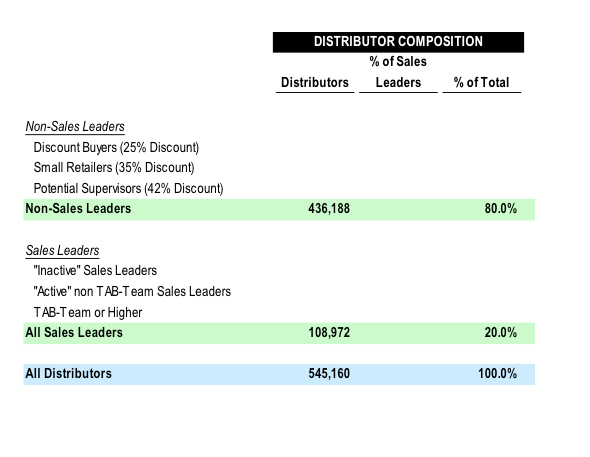
We start by creating a table with six categories of distributors. Three of these categories are for Non-Sales Leaders, which includes the category we are most interested in - Discount Buyers - as well as Small Retailers and Potential Supervisors.
There are also three categories of Sales Leaders (distributors who buy enough product from Herbalife in a year to qualify for commissions). These include Inactive Sales Leaders, distributors who bought enough to qualify for commissions but aren't regular buyers; Active non-TAB Team members, distributors on the lower end of the Sales Leader ladder who buy regularly; and Active TAB Team members, the highest-ranking Sales Leader who make regular purchases.
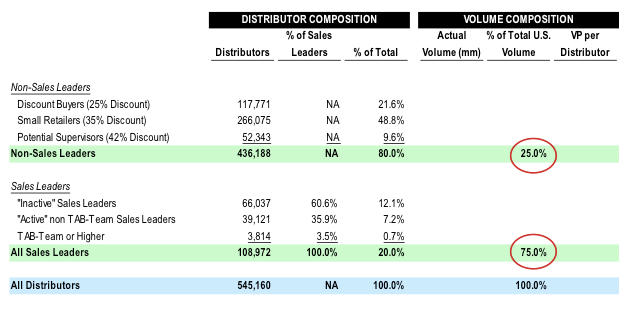
Herbalife's 2015 US Statement of Average Gross Compensation disclosure table along with its 10-K give us enough information to estimate the total number of distributors in the US and to break that into the number of Non-Sales Leaders and Sales Leaders, as follows:
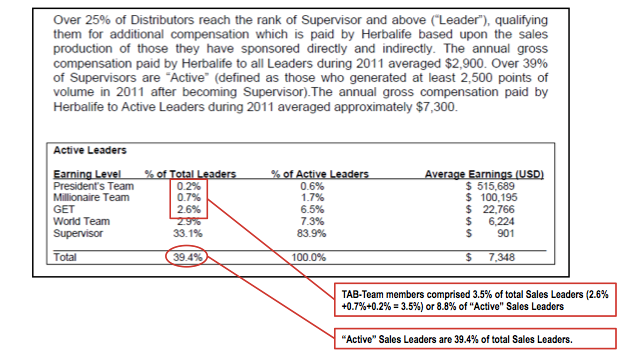
Herbalife's more detailed 2011 U.S. Statement of Average Gross Compensation, shown below, provides the basis for breaking Sales Leaders into different categories.
By applying this breakdown to the absolute numbers of Sales Leaders for 2015, we can determine the absolute numbers of Sales Leaders in each of our categories:
To determine the breakdown for non-Sales Leaders, we go back to Herbalife's May 1, 2012 earnings call when hedge fund manager David Einhorn phoned in with some questions, including: Why did Herbalife stop breaking out the various categories of non-Sales Leaders in its 2011 10-K?
Here's part of the answer, which the company filed in an 8-K:
We did not include the percentages from the 2011 Form 10-K in our more recent filings because we do not view the information as valuable to the business or to investors. For complete transparency, however, the full year 2011 information is as follows:
· Discount buyers were 27%
· Small retailers were 61%
· Potential supervisors were 12%
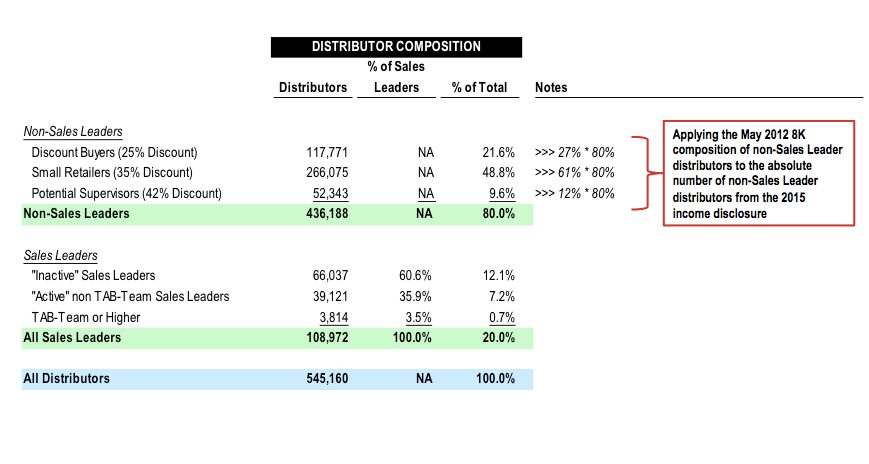
By applying these percentages to 2015 sales, we can fill in all the categories of non-Sales Leaders, including Discount Buyers.
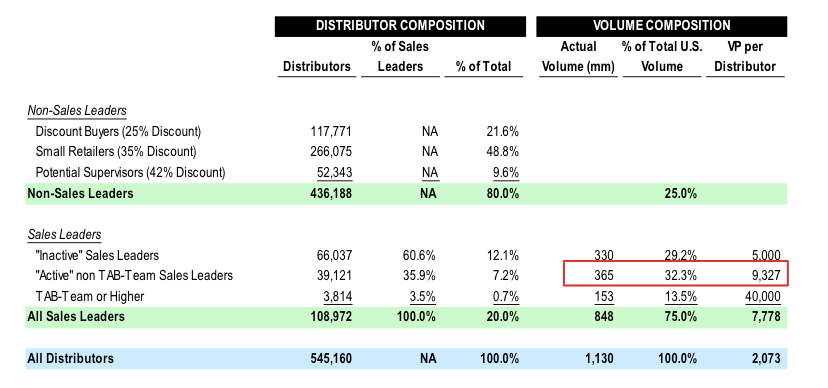
The result: Discount Buyers in the US totaled 117,771 in 2015 and made up 21.6% of all US distributors.
That's significantly lower than the figure Herbalife disclosed in 2012 when it said it 27% of its distributors fell into the Discount Buyer category. It's also a very disappointing number given the statements Herbalife has made in recent years about the vast majority of its distributors signing up just to get a discount on the products.
But let's keep going, because what we really want to know is how much of Herbalife's U.S. sales were made to these 117,711 Discount Buyers.
Discount Consumer Purchases
The FTC provided a crucial data point in its complaint that allows us to add volume composition to our table. The FTC stated that Sales Leaders purchaseat least 75% of Herbalife's products while non-Sales Leaders purchase less than 25%.
We add this information to the table.
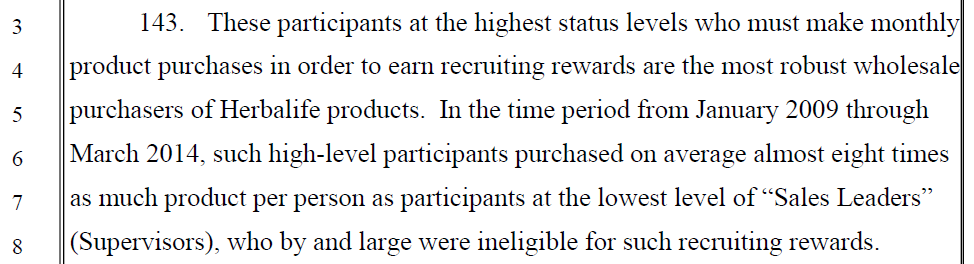
The FTC also provided a second piece of information in its complaint that allows us to break down the distribution of product purchases within the Sales Leader category. The agency noted that TAB Team members buy about 8x the amount of product purchased by lower level Sales Leaders.
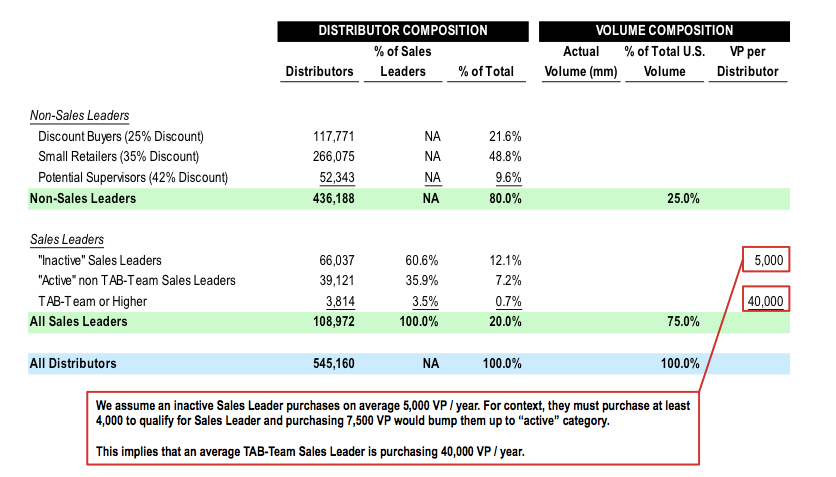
This will be helpful once we can establish how much Inactive Sales Leaders are purchasing. By consulting the Marketing Plan, we can make a reasonable estimate. We know they must be purchasing at least 4,000 volume points a year in order to be considered Sales Leaders. But they can't be purchasing 7,500 volume points or more or they would be considered Active Sales Leaders. So we estimate purchases of 5,000 volume points per year for each Inactive Sales Leader and add it to the table below.
Now, we can estimate that those in the TAB Team or Higher are buying on average 40,000 volume points a year because the FTC said that the average TAB Team member or Higher purchases about 8x the amount purchased by lower level Sales Leaders. We add the 40,000 volume points to the table.
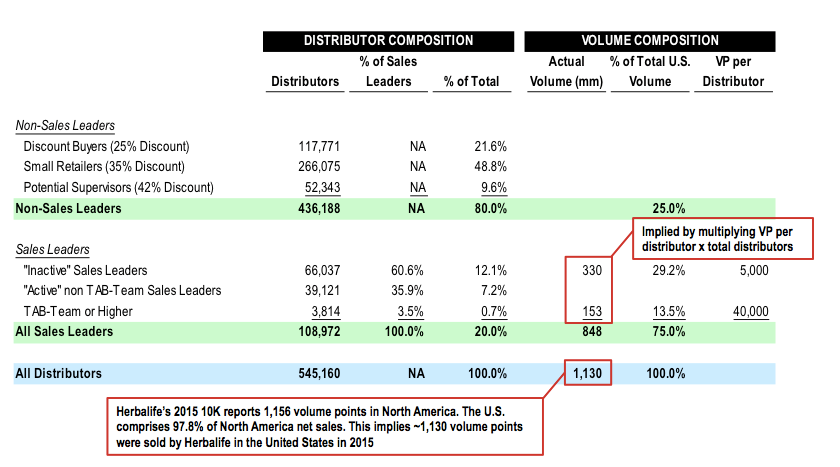
By multiplying the volume points per distributor by the total number of distributors in each category, we come up with the total volume points being purchased by these two groups of distributors:
Now we can plug in the missing values for Active Non-TAB Team, and we've established everything we need to know about the Sales Leader groups:
This leaves us to determine Non-Sales Leaders, including the crucial Discount Buyers - the individuals who interact with Herbalife solely to get a discount on the product and who must exist in substantial numbers in order to legitimize Herbalife's business in the eyes of the FTC.
In the 8-K Herbalife filed following David Einhorn's question back in May 2012, the company not only revealed the breakdown in Non-Sales Leaders by motivation, but it explained how it arrived at these various categories. The groups correspond to distributors who have achieved various levels in the marketing plan, which entitle them to different discounts on products:
· Potential Supervisors were buying at a 42% discount, putting them at the "Success Builder" level in the marketing plan.
· Small Retailers were buying at a 35% discount, making them "Senior Consultants."
· Discount Buyers were buying at a 25% discount, which is the discount available to "Distributors."
Using the marketing plan, we can estimate, on average, how much Potential Supervisors, a/k/a Success Builders, are buying. A Success Builder is defined as a distributor who has purchased 1,000 volume points in a month or 2,500 volume points over three months. If the distributor had purchased 4,000 volume points over a one-year period, he or she would have advanced to the higher level of Sales Leader. We therefore conservatively estimate that Potential Supervisors buy on average 2,000 volume points a year.
Again, using the marketing plan, we estimate that Small Retailers, a/k/a Senior Consultants, are buying on average 600 volume points a year. To reach the Senior Consultant level, an Herbalife distributor needs at least 500 volume points, but with more than 1,000 volume points in a month or 2,500 volume points over 3 months, the distributor would be bumped up to a Success Builder.
Using these estimates, we can now fill in the total amount of product purchased by these two groups of Non-Sales Leaders:
We now only need to plug in the missing values for Discount Buyers.
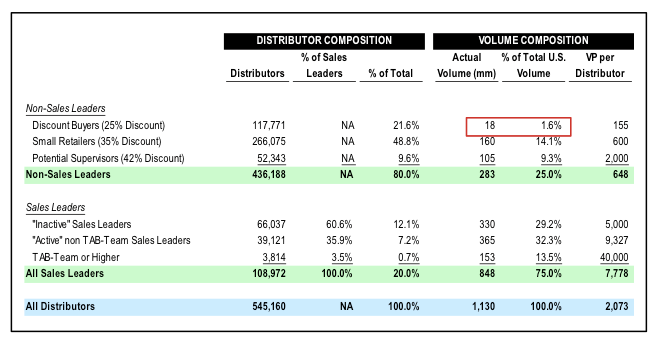
The result: Discount Buyers purchased 18 million volume points in 2015, accounting for just 1.6% of U.S. sales.
Falling Short
Let's review: The FTC says sales to Preferred Customers and to distributors who sell on to Retail Customers must account for two-thirds of Herbalife's sales, if the company is to continue to pay the same level of commissions to its distributors. We considered one category in this article - Preferred Customers - and estimated the size and importance of this group by reconstructing the ranks of Discount Buyers, a metric Herbalife stopped regularly disclosing in 2012.
Recall that Herbalife set our expectations very high for this group, with periodic claims such as CEO Michael Johnson's statement in 2013 that 90% of distributors sign up for one reason only - to consume the product.
Discount Buyers are vital to legitimizing Herbalife's U.S. business because they have no interest in pursuing the business. They are a testament to the underlying demand for the products. These individuals are so pleased with Herbalife products that they are willing to make an upfront payment in order to get discounts on future purchases and they're willing to go through the hassle of signing a contract in order to get that discount. They are what one might call "loyal customers."
The problem is that they make up only 22% of all distributors, and they buy less than 2% of the product Herbalife sells in the US.
They are essentially irrelevant.

Christine Richard (copyright 2016)

Saturday, 15 October 2016

'Nu Skin (NUS)' racketeers will pay $47 millions to shareholders and stay out of jail.

See original image

________________________________

See original image

Judge gives final approval to $47M settlement of Nu Skin shareholder lawsuit


A federal judge on Thursday gave final approval to a settlement in a shareholder lawsuit against Nu Skin Enterprises in which the company agreed to pay $47 million over allegations it had operated an illegal pyramid scheme in China which it failed to disclose, even as it reported soaring earnings.
The Provo-based multi-level marketer of personal care products and nutritional supplements reached the settlement earlier this year and U.S. District Judge Jill Parrish on Thursday gave final approval, and also Ok'd a distribution plan and awarded attorney fees. Nu Skin said it and individual officers named in the lawsuit continue to deny the allegations.
Nu Skin was sued after Chinese authorities cracked down on its operations following allegations that Nu Skin was operating a multi-level marketing scheme in violation of the country's laws.
A multi-level marketing business model uses a network of independent distributors who earn bonuses for recruiting others into the company. The lawsuit alleged the scheme depends on the company's ability to constantly recruit new distributors to replace those who quit and move into new markets when older ones slow. Such operations are legal in some form or another in most countries, but not China.
The lawsuit alleged that in order to offset slow growth in  Nu Skin's major markets, the company in 2011 "put on steroids" its MLM operation in China. But it also failed to disclose to shareholders what it was doing to jack up sales, and each quarter touted its remarkable growth in revenue, the suit alleged.
By the end of 2013, Nu Skin's sales in China reached more than $1 billion, and its shares soared.
Individual defendants, including CEO Truman Hunt and CFO Ritch Wood, then unloaded about $40 million in shares at an inflated price, the lawsuit claimed.
In January of 2014, a Chinese newspaper alleged violations of Chinese laws and authorities launched investigations, though the company has pointed out the government did not find violations of its MLM laws.
In September, however, Nu Skin agreed to pay the Securities and Exchange Commission about $766,000 to settle allegations that a Chinese employee had paid about $154,000 to a charity in order to influence a high-ranking Chinese Communist Party official. The payment was made to affect the outcome of an investigation into the company's operations in a Chinese province, the SEC said.
Parrish on Thursday also granted $13.6 million in attorney fees, or 29 percent of the settlement. The New York firm of Labaton Sucharow provided lead attorneys for the plaintiffs.

http://www.sltrib.com/news/4465438-155/judge-gives-final-approval-to-47m

Monday, 10 October 2016

'Herbalife (HLF)' deploys yet more 'Scientology'-style tactics.

The director of a documentary critical of Herbalife says a lobbying firm employed by the nutritional supplement company, Heather Podesta + Partners, tried to keep a Washington audience away from a screening. 
Ted Braun, the writer and director of “Betting On Zero,” says 10 people who work for Podesta’s firm purchased 173 tickets — roughly half the seats — to a showing of the movie at the Double Exposure film festival Friday night at the National Portrait Gallery. The tickets, which the Podesta staffers bought in batches, were never picked up, and the seats went vacant, festival organizers said.
In a statement, Braun called the move a “deliberate attempt to thwart an interested D.C. audience from seeing our documentary.”
The movie is unflattering to Herbalife and its use of a citizen sales force. Its hero is hedge-funder and prominent critic Bill Ackman, who charges that the company’s tactics amount to a pyramid scheme. Herbalife has pushed back against the film, including buying the domainbettingonzero.com and creating a website critical of it. The company has also reportedly spent tens of millions, including on “Democratic operatives, three public relations firms and two law firms stacked with former prosecutors,” according to the New York Times, in an effort to counter Ackman’s campaign against the company.
Neither Podesta nor an Herbalife spokeswoman immediately responded to requests for comment.
In the statement, Braun noted that the screening was part of an event meant to highlight revealing films. “In the context of a festival devoted to investigative filmmaking such actions are particularly questionable and disappointing for a publicly traded company operating in an open democracy.”


Washington Post (copyright 2016)

________________________________________________
See original image

Herbalife Ltd. claimed victory over Bill Ackman when it settled with the Federal Trade Commission in July, but it’s still fighting the activist hedge-fund manager on every front it can.
Case in point: Friday night, the documentary that features Mr. Ackman’s campaignagainst the nutritional-products company had a screening at a film festival in Washington D.C.
The theater was half empty, according to those there, and the director blamed Herbalife.
Ted Braun, director of “Betting on Zero,” told the audience before the showing that Herbalife’s lobbyists had bought 173 tickets but no one claimed them, according to a video reviewed by MoneyBeat.
“I had hoped this would at last allow us a chance to engage in an open discussion about the merits of the film and about Herbalife’s endeavors,” Mr. Braun told the audience. In a statement he criticized the move as “another step by Herbalife to avoid the serious questions raised by the film.”
Buying 173 tickets to the showing would have cost more than $2,850, including an online convenience fee, according to Double Exposure festival’s website.
Herbalife didn’t respond to a request for comment.
Herbalife has made a point of discrediting the film since its debut this year, even buying the website “bettingonzero.com” where it has posted about Mr. Braun and Mr. Ackman, accusing them of “manufacturing” a grass-roots campaign for the film. It’s also criticized the film’s funding from another short seller who has been betting against the company.
Mr. Braun has said he made the film to depict the battle between the two sides and tried to get Herbalife to participate. He said he attempted to get Herbalife to come to the screening but they didn’t respond.
Friday’s efforts are just the latest in Herbalife’s continuing battle with Mr. Ackman since the FTC settlement. The company has released political-attack style videos about Mr. Ackman on its website “therealbillackman.com” and mailed to media members a 158-page book that includes “recent media coverage” that’s largely negative about Mr. Ackman.
The FTC settlement in July imposes changes to Herbalife’s business that will force the company to prove it has underlying sales. The company says it will produce the evidence, including receipts. The stock shot up the day of the settlement, but has since dropped back below.
Mr. Ackman has stuck by his version and says the FTC complaint will threaten the business.
The stock is up 18% this year, roughly double Mr. Ackman’s break-even price.
Wall Street Journal (copyright 2016)